- Nuclear Update
- Posts
- ⚛️ Breeding the Future
⚛️ Breeding the Future
PLUS: First U.S. Reactor Approved in a Decade

Welcome to Nuclear Update!
I’m back, although still running on partial sleep and a questionable caffeine strategy.
A few guest pieces were prepared while I was temporarily occupied with newborn reactor operations, so I want to publish those before we return fully to normal programming.
That said, last week delivered exactly the kind of headline that fits this edition perfectly.
⚛️First U.S. Reactor Approved in a Decade
The U.S. Nuclear Regulatory Commission has approved TerraPower’s construction permit for Kemmerer Unit 1, the first commercial reactor construction approval in the United States in nearly 10 years.
It is also the first approval for a non-light-water reactor in more than 40 years. Even more notable, the NRC completed the technical review in under 18 months, extremely fast for a first-of-a-kind advanced design.
And fittingly, that brings us straight into Part II of Alex Kovnat’s guest edition.
Last week, Alex explained why light water reactors leave efficiency on the table. (If you missed last week’s edition, you can read it here.)
This week, he moves to the fuel question: why today’s reactors extract only a tiny fraction of uranium’s potential energy, and what changes when fast reactors, breeder systems, and alternative fuel cycles enter the picture.
And in a nice full circle, he ends where this week began: with Natrium, fast reactors, and the designs now moving from theory into permits.
Over to Alex.
But first: this week’s trivia question:
What is the maximum number of electrons the first electron shell can hold? |
Last week, I asked:
Which gas is most responsible for Earth’s natural greenhouse effect?
You said:
⬜️⬜️⬜️⬜️⬜️⬜️ Oxygen (3%)
🟨🟨🟨🟨🟨🟨 Carbon monoxide (52%)
🟩🟩🟩🟩⬜️⬜️ Water vapor (35%)
🟨⬜️⬜️⬜️⬜️⬜️ Nitrogen (10%)
Now, let’s dive into the good stuff!💥

⚛️ Breeding the Future
♻️Why 99% Stays Unused
A disadvantage of our present light water reactor technology, is that less than i% of uranium is utilized to produce heat.
Although the percentage of fissile U-235 in natural uranium is 0.7%, the percentage of uranium that ends up producing heat would be even lower were it not heat production from plutonium formed and fissioned in situ (ie, in place).
If spent nuclear fuel from present nuclear power plants were to be reprocessed and the plutonium content recycled, uranium utilization would improve by ~30% according to Processing of Used Nuclear Fuel - World Nuclear Association.
According to a technical paper “On High Conversion Ratio Light Water Reactors” authored by Milton C. EDLUND Virginia Polytechnic Institute and State University, Blacksburg, Virginia 24061 Received March 24, 1987 published in the journal Nuclear Technology in January 1988, an optimized pressurized water reactor core could attain a conversion ratio of up to 0.9, resulting in uranium utilization of ~4% with plutonium recycling.
🧪Breeding With Thorium
Another variation of light water reactors capable of extending our nuclear fuel resources, is the late U.S. Navy Vice Admiral Hyman Rickover’s Light Water Breeder Reactor. This concept was put into effect in 1977 with the Shippingport power plant. The LWBR operates on the Thorium-U233 fuel cycle rather than U238-Pu239.
According to an article in Atomic Insights published in October 1995 Light Water Breeder Reactor: Adapting A Proven System – Atomic Insights:
At 12:30 am, on August 26, 1977, the operators at the Shippingport Atomic Power Station began lifting the central modules of the experimental breeder reactor core into the blanket section.
At 04:38 am, the reactor reached criticality. During the next five years, the core produced more than 10 billion kilowatt-hours of thermal power – equivalent to about 2.5 billion kilowatt hours of electrical power – with a current retail value of approximately $200 million.
It showed no signs of approaching the end of its useful life. It was obvious from the core performance that the reactor was at least a very efficient converter with a long life core.
However, in October, 1982, the reactor was shut down for the final time under budgetary pressures and a desire to conduct the detailed fuel examination needed to determine if breeding had actually occurred.
A report on the experiment was quietly issued in 1987. The core contained approximately 1.3% more fissile material after producing heat for five years than it did before initial operation.
Breeding had occurred in a light water reactor system using most of the same equipment as used for conventional reactor plants.
Finally the author puts forward:
The light water breeder reactor was a technical success. It demonstrated a sophisticated way to more effectively use a proven technology and to make better use of natural resources. It even demonstrated a way to significantly reduce the volume of high level nuclear waste per unit of electrical power output.
But even if such high conversion or breeder reactors based on light water were to be built, they would still suffer the disadvantage of low thermodynamic efficiency. With high conversion LWR’s using the U238-Pu239 cycle, their uranium utilization would still be low. So the nuclear power industry must pursue development of breeder reactors operating at high temperatures in one form or another.
According to a conference on fast reactors:
The role of fast reactors comes in various forms. The fast reactors should be, in principle, able to extract almost all energy contained in uranium.
The light water reactors (LWR) use a percent of the energy that is available in uranium, 99% of uranium is not used, it is a resource not being utilized.
The efficiency of fast reactors is also much better, around 40%, because they are high temperature systems. Whereas the thermal reactors operate at 300-350°C, the fast reactors operate at 500-600°C and might go even higher.
🧂Molten Salt Changes the Game
One category of reactor which promises both thermodynamic efficiency and breeding, using the thorium fuel cycle, is molten salt reactors. According to a Google search:
A Molten Salt Breeder Reactor (MSBR) is an advanced nuclear reactor concept using liquid fuel (uranium/thorium dissolved in molten salt) that produces more fissile fuel than it consumes, extending resources, operating at low pressure, and offering potential advantages in safety and waste reduction by using thorium cycles, with designs like two-fluid systems and single-fluid versions being researched, stemming from 1960s U.S. efforts like the MSRE at Oak Ridge National Laboratory.
Molten Salts are a promising coolant and fuel carrier for high temperature reactors.
According to the The World Nuclear Association website:
Fluoride salts boil at around 1400°C at atmospheric pressure, so allow several options for use of the heat, including using helium in a secondary Brayton cycle circuit with thermal efficiencies of 48% at 750°C to 59% at 1000°C, for manufacture of hydrogen.
Fluoride salts have a very high boiling temperature, very low vapour pressure even at red heat, very high volumetric heat capacity (4670 kJ/m3 for FLiBe, higher than water at 75 atm pressure), good heat transfer properties, low neutron absorption, good neutron moderation capability, are not damaged by radiation, are chemically very stable so absorb all fission products well and do not react violently with air or water, are compatible with graphite, and some are also inert to some common structural metals.
Some gamma-active F-20 is formed by neutron capture, but has very short half-life (11 seconds).
The World Nuclear Association website states, on the matter of thorium cycle reactors:
Molten Salt Reactors (MSRs): These reactors are still at the design stage but are likely to be very well suited for using thorium as a fuel.
The unique fluid fuel can incorporate thorium and uranium (U-233 and/or U-235) fluorides as part of a salt mixture that melts in the range 400-700ºC, and this liquid serves as both heat transfer fluid and the matrix for the fissioning fuel.
The fluid circulates through a core region and then through a chemical processing circuit that removes various fission products (poisons) and/or the valuable U-233.
The level of moderation is given by the amount of graphite built into the core. Certain MSR designs will be designed specifically for thorium fuels to produce useful amounts of U-233.
🌍Fast Reactors Return
The form of nuclear power reactor in which I wrote my Master of Science in Nuclear Engineering thesis in 1973, is fast-neutron breeder reactors, most likely using sodium as the coolant.
The Liquid Metal Fast Breeder Reactor (LMFBR) was the principal form of power reactor based on the U238-Pu239 fuel cycle studied extensively by the U.S. Atomic Energy Commission from the 1950 timeframe when EBR-1 (Experimental Breeder Reactor 1) first went critical, until 1977 when the President Jimmy Carter infinitely deferred plutonium and the Clinch River LMFBR program (President Carter did however, support the Light Water Breeder effort).
Later on, spent fuel recycling and various advanced reactors were re-instated.
According to American Nuclear Society Position Statement #74 (November 2005):
The American Nuclear Society believes that the development and deployment of advanced nuclear reactors based on fast-neutron fission technology is important to the sustainability, reliability, and security of the world’s long-term energy supply.
Of the known and proven energy technologies, only nuclear fission can provide the large quantities of energy required by industrial societies in a sustainable and environmentally acceptable manner.
Natural uranium mined from the earth’s crust is composed primarily of two isotopes: 99.3% is U-238, and 0.7% is the fissile U-235.
Nearly all current power reactors are of the “thermal neutron” design, and their capability to extract the potential energy in the uranium fuel is limited to less than 1% of that available.
The remainder of the potential energy is left unused in the spent fuel and in the uranium, depleted in U-235, that remains from the process of enriching the natural uranium in the isotope U-235 for use in thermal reactors.
With known fast reactor technology, this unutilized energy can be harvested, thereby extending by a hundred-fold the amount of energy extracted from the same amount of mined uranium.
According to the International Conference on Fast Reactors and Related Fuel Cycles held in Vienna in April 2022:
At present, many countries are actively developing reactor, coolant, fuel and fuel cycle technologies. Fast reactor technologies include sodium, lead, lead-bismuth eutectic, gas, molten salt and supercritical water-cooled systems, as well as hybrids, such as accelerator driven systems.
A noteworthy aspect of fast-neutron reactors is that with a high energy (fast) neutron spectrum, a small but noticeable percentage of heat energy comes from direct fission of U-238, thus bypassing the U238-Pu239 cycle.
In addition, actinide elements present in spent reactor fuel – Americium (element 95), Curium (element 96), Berkelium (97) and Californium (98) – are readily usable as fuel in fast reactors.
Presently, the world’s leader in LMFBR’s is Russia. Their long-term goal is to go to fast neutron reactors and closed fuel cycle.
They have carried out extensive studies of lead and lead-bismuth in lieu of sodium as fast reactor coolant. Owing to availability of large quantities of weapon-grade plutonium, present and early-generation of Russian fast reactors are now geared to fissioning their excess plutonium.
The oldest currently operating Russian large sodium-cooled fast reactor, BN-600, has been in service since 1980. Another such, BN-800 has been operating since 2014. In 2022, BN-800 began operating with a mixed oxide (uranium plus plutonium) core.
Presently, the Russian fast reactor development effort has turned to lead-cooled designs. Per the WNA website:
Recent priority in financing has been for lead-cooled fast neutron reactors with dense nitride fuel.
Initially two projects were proposed – the BREST-300 lead-cooled fast reactor with associated nitride fuel fabricating/re-fabricating and spent fuel reprocessing facilities and the SVBR-100 lead-bismuth fast reactor, since dropped.
Hence from the mid-2020s, fast reactors will be new designs such as BREST with a single core and no blanket assembly for plutonium production.
The first BREST-OD-300 reactor commenced construction in June 2021 at Seversk.
China, France, India, Japan, the Republic of Korea, the European Commission as well as the Russian Federation have contributed to fast neutron reactor research. https://www-pub.iaea.org/MTCD/Publications?PDF/PUB2111web.pdf is a full report on the aforementioned 2022 conference.
For those that are interested in the matter of breeding, I refer you to this web link:
France at one time operated fast reactors. There was Phenix, which operated from 1973 to 2009, and then there was Superphenix, which was shut down in 1998. The Phenix reactor proved the feasibility of closed fuel cycle, and was designated a nuclear historic landmark by the American Nuclear Society in 1997. Phenix demonstrated a breeding ratio of 1.16.
France derives 70% of its electric power from nuclear power plants. At one time, opposition to nuclear power resulted in plans to reduce nuclear power’s share of electric power to 25%, but in 2023 the political climate in France changed and the above planned reduction in nuclear power was abandoned.
In addition, France is recycling nuclear fuel.
Europe has been investigating lead-cooled fast reactors. An example of prototype lead cooled reactors is the Advanced Lead Fast Reactor European Demonstrator (ALFRED), seen as a prelude to a prototype LFR (PROLFR) of 300-400 MWe online about 2035, and then an industrial scale unit of about 600 MWe (European Lead-cooled Fast Reactor, ELFR).
⚛️ From Theory to Natrium
I would like to mention one more topic before I close this report out. Mention has been made of advanced nuclear reactors being fast-tracked by the Department of Energy for further development. One such is the Natrium reactor, to be built in Kemmerer, Wyoming on the site of a to-be-retired coal-burning power plant.
Natrium (Latin for sodium) is a 345-megawatt electric (MWe) sodium-cooled fast reactor paired with a molten salt energy storage system. It was developed by TerraPower and GE Hitachi. Fuel for Natrium is High-Assay, Low-Enriched Uranium (HALEU) metal fuel.
A noteworthy aspect of Natrium is an integrated molten salt storage system that can boost the system's output to 500 MWe for over 5.5 hours.
The Natrium will produce electric power at higher thermodynamic efficiency than the light water reactors we presently have, thus (everything else being equal) consuming less uranium. But in order to reduce consumption of mined uranium as much as possible, it will be necessary to reprocess spent fuel and recycle plutonium, perhaps as a U-Pu-Zr alloy or U-Pu nitride.
Another nuclear power concept being fast-tracked, is the Xe-100. This is a high-temperature helium cooled modular reactor which will use TRISO fuel elements. As with the Natrium reactor, it will produce electric power with greater thermodynamic efficiency. But again, to reduce demand for mined uranium as much as possible, it will be advisable to adapt this design for use with the thorium fuel cycle.
Huge thanks to Alex for contributing this two-part guest edition, and for bringing decades of nuclear engineering perspective into Nuclear Update.
What makes it especially interesting is how many of the ideas he studied years ago are now showing up again in real projects, from fast reactors to Natrium.
Sometimes the nuclear sector takes a long time to catch up with itself.
-Fredrik
Like the newsletter and want to support it? Join Premium.
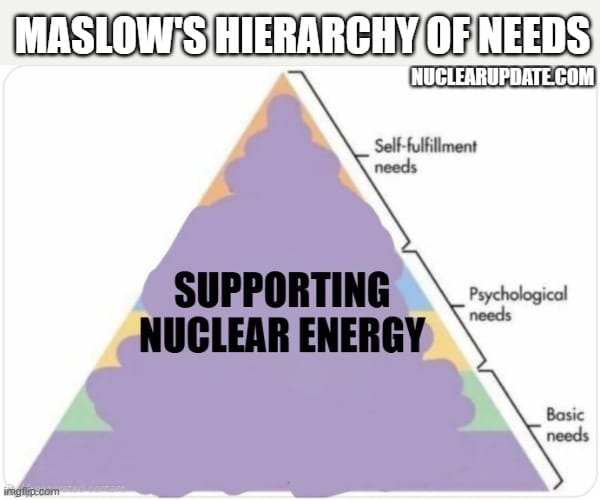
😂Meme of The Week
💪Review of the Week

What did you think of this week's email? |
DISCLAIMER: The content in this article is for informational and educational purposes only and is not financial advice. It should not be interpreted as a recommendation or solicitation to buy or sell any securities. Markets move quickly, opinions can change, and outcomes are uncertain. Always consult a licensed professional before making any investment decisions. Nuclear Update and its authors are not responsible for any gains or losses arising from the use of this information.
Reply