- Nuclear Update
- Posts
- ⚛️DOE FY27 Budget Requests $45 Billion in Nuclear Funding
⚛️DOE FY27 Budget Requests $45 Billion in Nuclear Funding
PLUS: Diablo Canyon Gets a 20-Year License
Welcome to Nuclear Update, the newsletter that’s like a Möbius strip… no clear beginning, no clear end, just one continuous loop of information.
This is what I’ve got for you this week:
⚛️ DOE FY27 Budget Requests $45 Billion in Nuclear Funding
🌊 Diablo Canyon Gets a 20-Year License Extension
✈️ The U.S. Air Force Wants Reactors
✍️ Guest Post: A Picture Worth a Thousand Megawatts
But first, this week’s trivia question:
Which of the following is a measure of acceleration? |
Last week, I asked:
Which principle states that you cannot know both the exact position and momentum of a particle at the same time?
You said:
⬜️⬜️⬜️⬜️⬜️⬜️ Pauli exclusion principle (7%)
🟩🟩🟩🟩🟩🟩 Heisenberg uncertainty principle (78%)
⬜️⬜️⬜️⬜️⬜️⬜️ Newton’s third law (10%)
⬜️⬜️⬜️⬜️⬜️⬜️ Coulomb’s law (5%)
Now, let’s dive into the good stuff! 💥

⚛️DOE FY27 Budget Requests $45 Billion in Nuclear Funding
The government just handed nuclear a budget that would make a reactor engineer blush (or glow).
The White House has proposed $53.9 billion for the Department of Energy in fiscal year 2027, a nearly $5 billion increase from 2026 levels.
Hidden deep inside, buried on page 15 (I guess not that deep) of the budget document is a line that tells you everything you need to know about where Washington's energy priorities now sit: 80% of that entire budget goes to nuclear.
The National Nuclear Security Administration (NNSA) gets the biggest slice at $32.8 billion, a 12% jump or $3.6 billion more than last year. That covers warhead modernization, life-extension programs, next-generation naval reactor technology, and nuclear emergency response.
The remaining $21.1 billion covers civilian DOE programs. The budget includes $3.5 billion specifically to "rapidly deploy firm baseload power".
The document doesn't spell out exactly what falls under that line, but the administration's preferred baseload options are not a mystery.
Another $1.2 billion goes toward AI infrastructure at Argonne and Oak Ridge National Laboratories, which ties directly into reactor design, materials modeling, and advanced fuel cycle work.
To pay for all of it, the administration cut $2.7 billion by eliminating what the budget document bluntly calls "Green New Scam initiatives" and DEI programs.
The Office of Energy Efficiency and Renewable Energy was abolished in 2026. Its replacement, the Office of Critical Minerals and Energy Innovation, gets $1.1 billion, refocused entirely on supply chains and next-generation energy manufacturing.
Environmental Management gets $8.2 billion, down $386 million, with roughly $3 billion going to Hanford in Washington state. That money cleans up Cold War weapons sites, reduces long-term federal liability, and in some cases frees up land that could host new nuclear infrastructure.
Of course, the budget is a proposal, not a guarantee. Congress still has to pass it. But the White House putting 80% of its energy department budget behind nuclear is something we could only dream about a few years ago.
You can read the full budget HERE.
🌊 Diablo Canyon Gets a 20-Year License Extension
This one has been a long time coming.
On April 2, the Nuclear Regulatory Commission approved PG&E's application to renew the operating licenses for Diablo Canyon Power Plant, California's last remaining nuclear facility, for another 20 years.
Unit 1 is now licensed through November 2044. Unit 2 through August 2045.
It also marked the NRC's 100th renewed operating license for a U.S. power plant. Not a bad milestone to land on.
Diablo Canyon’s 2 PWRs generate 2,200 MW of clean baseload power, nearly 9% of California's total electricity supply.
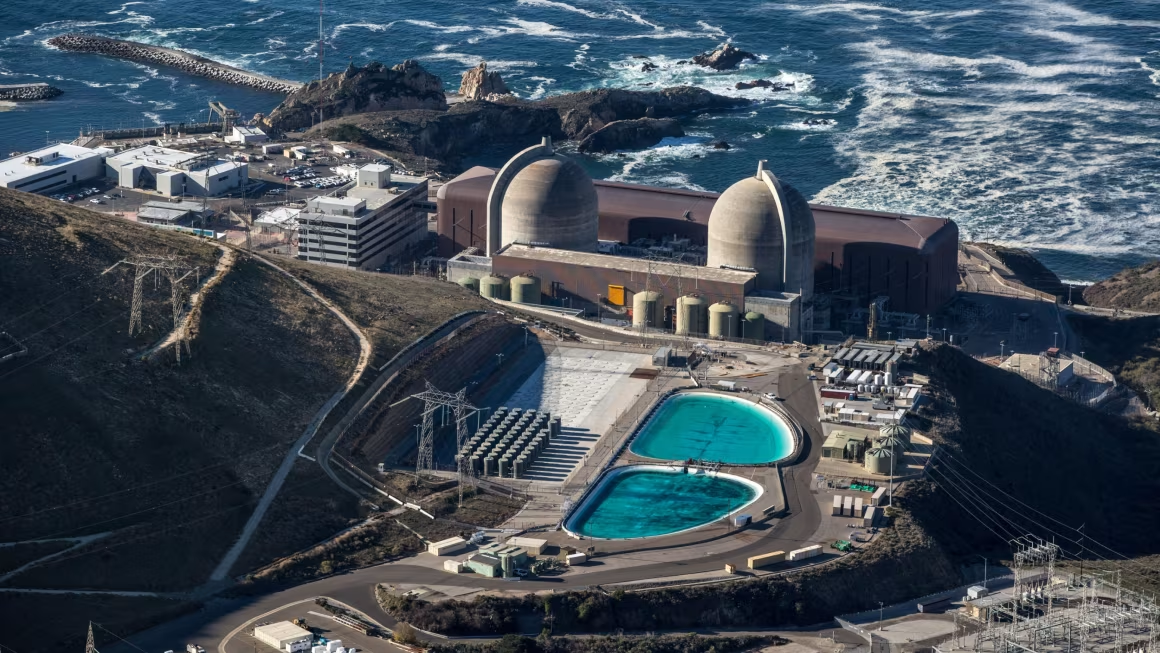
Diablo Canyon
The plant was originally supposed to be dead by now.
PG&E agreed to retire it back in 2016. Then the energy math stopped working out. California's grid kept tightening, demand kept rising, and it turned out that replacing always-on nuclear with intermittent renewables was harder than the press releases made it sound.
By 2022, Governor Newsom reversed course and pushed to keep it open.
There is a catch: California state law still caps operations at 2030. Getting Diablo Canyon to run all the way to 2044 and 2045 requires the state Legislature to act. And a bill that would effectively lift California's nuclear moratorium entirely is scheduled for a hearing on April 13.
A state that spent a decade trying to close its last nuclear plant is now debating whether to lift the ban on building new ones.
If that isn't a full-circle moment, nothing is.
The NRC renewed 13 reactor licenses in 2025. Diablo Canyon's 2 units bring the running total to 15 renewals since the start of last year. At roughly 450,000 pounds of uranium per reactor per year, that's nearly 6.75 million pounds of additional annual uranium demand locked in and guaranteed for the next 20 years.
How many new uranium mines have come online since then to meet it? Zero.
The supply side hasn't moved. The demand side keeps stacking.
If you want to know how to position around that gap before the market catches up, that's exactly what we cover every week in Nuclear Update Premium: uranium prices, market sentiment, portfolio moves, and where we are in the cycle.
✈️ The U.S. Air Force Wants Reactors at Its Bases
The U.S. Navy has been running nuclear reactors for 70 years. The Air Force just looked at that track record and thought: we want some of that.
In late March, the Air Force posted a Request for Information asking companies whether they can design, license, fuel, construct, and deploy small nuclear reactors at military installations.
The range they're interested in: 1 to 300 MWe. Responses are due April 19.
This isn't coming out of nowhere.
Back in February, the Air Force made history with Operation Windlord, the first-ever airlift of a nuclear reactor via C-17 Globemaster III.
Valar Atomics' Ward 250, a 5 MWe microreactor, was loaded onto 3 aircraft at March Air Reserve Base in California and flown to Hill Air Force Base in Utah.
The point of the exercise was to prove that a next-generation reactor can be transported, deployed, and operated without a fixed grid.
A forward air base, a radar installation, a command post, anywhere that currently depends on fuel convoys or fragile civilian infrastructure, becomes energy independent. No power lines. No resupply runs. Just a reactor running for years.
The Navy figured out decades ago that nuclear power makes a ship unstoppable. The Air Force is now asking whether it can do the same thing for a base.
Check out operation Windlord here:
✍️ Guest Post: A Picture Worth a Thousand Megawatts
Bob Ciminel is back. For those who missed his earlier piece, Bob spent more than 40 years in nuclear power, including seven years running naval nuclear propulsion plants.
This time, Bob takes us back to a morning at Sequoyah Nuclear Plant in 2004, where a single photograph captured something the industry of the 1970s wouldn't have believed possible.
By Bob Ciminel
There is an adage that one picture is worth a thousand words. I will keep that in mind as I draft this story about a picture.
I took this photograph in 2004 while conducting a crew performance observation at the Tennessee Valley Authority Sequoyah Nuclear Plant near Chattanooga, Tennessee. The image shows the Unit 1 control room and the crew that was on duty that morning.
If this were the 1970s, when I entered the commercial nuclear industry, no one would believe that it was not a photograph posed. To the best of my knowledge, women were rare in nuclear power plants, other than in administrative or non-operating jobs.
The first woman to obtain a U.S. Atomic Energy Commission operating license was Roberta Kankus in 1973, and the first woman to receive a Senior Reactor Operator license was Carolyn Heising in 1980. That does not mean women were absent in the nuclear field.
Leona Woods was a member (and the only woman) of the team that built the first man-made reactor, Chicago Pile 1. Thousands of young ladies operated the Calutron uranium enrichment machines at Oak Ridge during the Manhattan Project. And, of course, Lise Meitner was one of the researchers who discovered nuclear fission, the element Protactinium (91), and the Auger Effect (electrons from atoms emitted at discrete energy levels).
My photograph is the Hockey equivalent of a “Hat Trick” (three consecutive goals by the same player). The ladies in the photo are the Control Room Supervisor and Reactor Operators in charge of Sequoyah Unit 1, along with the station Operations Manager who joined them at my request.
The photograph is 25 years old, I have been retired since 2014, and I am sure these ladies have moved on in their careers or joined me in retirement. I appreciate their letting me record them for posterity.
And, as promised, I kept this to less than 1,000 words.
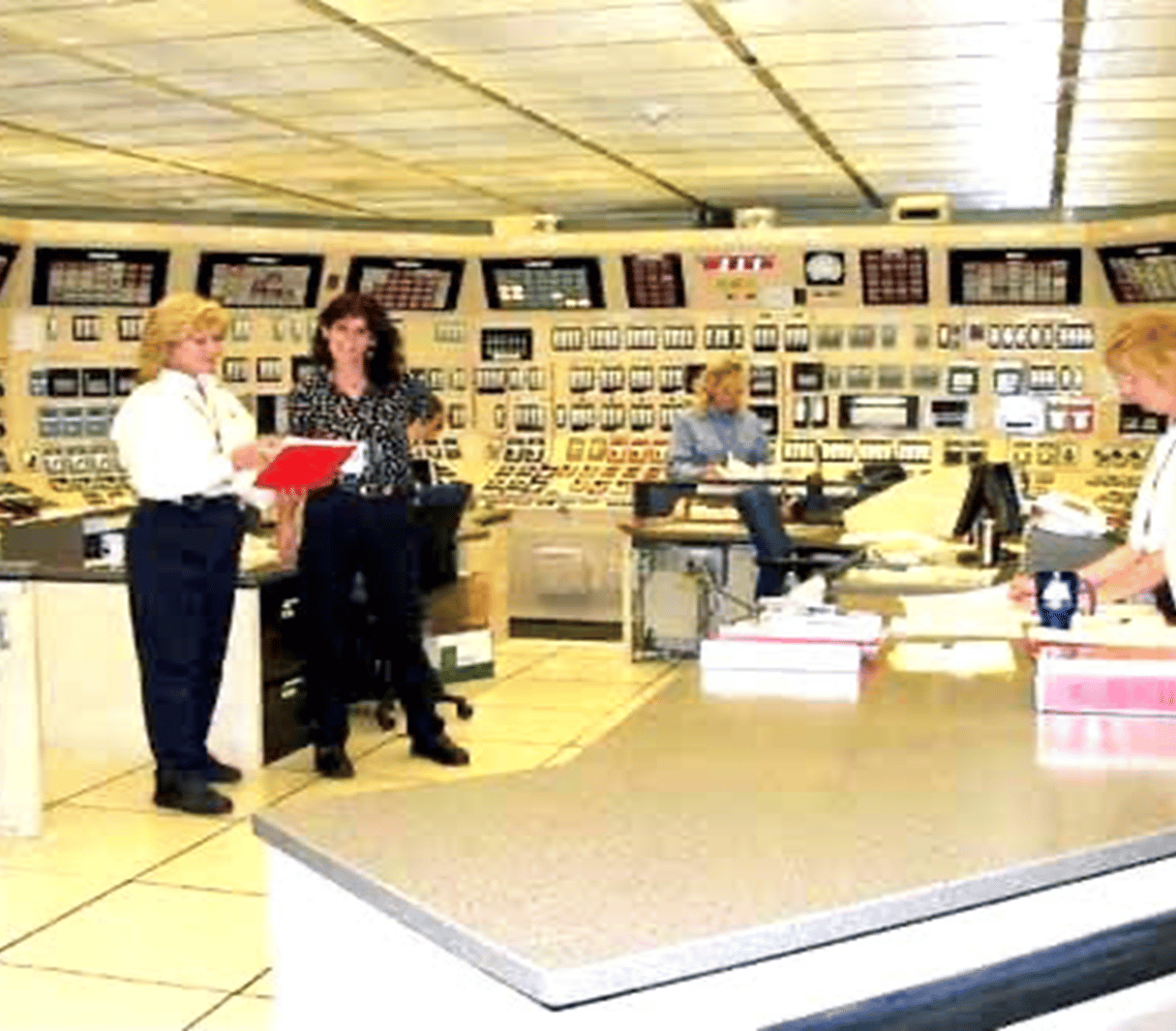
Big thanks to Bob for this one. A photograph that wouldn't have been believable in the 1970s, now just a normal Tuesday morning at a nuclear plant. That's progress worth recording.
That’s a wrap for this week.
Until next time: be like Diablo Canyon. Refuse to be shut down. Keep glowing 😎
-Fredrik
Like the newsletter and want to support it? Join Premium.
😂Meme of The Week
💪Review of the Week

DISCLAIMER: The content in this article is for informational and educational purposes only and is not financial advice. It should not be interpreted as a recommendation or solicitation to buy or sell any securities. Markets move quickly, opinions can change, and outcomes are uncertain. Always consult a licensed professional before making any investment decisions. Nuclear Update and its authors are not responsible for any gains or losses arising from the use of this information.
Reply