- Nuclear Update
- Posts
- ⚛️DOE Just Fast-Tracked Advanced Reactors
⚛️DOE Just Fast-Tracked Advanced Reactors
PLUS: NextEra Just Became Nuclear Mercenaries
Welcome to Nuclear Update, the newsletter where we hunt for quantum ducks. Quark! Quark!🦆
This is what I’ve got for you this week:
⚛️DOE Just Fast-Tracked Advanced Reactors
⚔️NextEra Just Became Nuclear Mercenaries
🇺🇿Uzbekistan to Pour First Concrete for SMRs
☢️ Gamma Sensors Made From Plastic Beads
But first: this week’s trivia question:
Which of the following is an example of potential energy? |
Last week, I asked: A car travels at a constant speed of 40 miles per hour. How far does the car travel in 45 minutes?
You said:
⬜️⬜️⬜️⬜️⬜️⬜️ 25 miles (2%)
🟩🟩🟩🟩🟩🟩 30 miles (86%)
⬜️⬜️⬜️⬜️⬜️⬜️ 35 miles (7%)
⬜️⬜️⬜️⬜️⬜️⬜️ 40 miles (5%)
Now, let’s dive into the good stuff!💥

⚛️DOE Just Fast-Tracked Advanced Reactors
You know the airport line where the guy in front forgets his belt, then his watch, then somehow discovers he has coins also?
That’s advanced nuclear permitting.
And DOE just opened a fast-track lane for advanced reactors.
DOE has added a new shortcut to NEPA, the federal environmental review rulebook.
As of February 2, 2026, certain DOE backed advanced reactor projects can qualify for a categorical exclusion, meaning they may skip the full environmental assessment or impact statement process.
In plain English: advanced nuclear projects no longer have to go through the full, slow, multi-year environmental review process.
That is DOE officially saying modern advanced reactors are predictable enough, and safe enough by design, that they don’t automatically warrant the same review burden as older infrastructure.
This applies when DOE is the lead federal agency, like projects on federal land or reactors backed by DOE funding or loan guarantees, both pilot and commercial projects.
Private NRC projects still follow their normal path.
The logic is simple. Advanced reactors use different fuel forms, passive safety systems, and designs that limit worst-case scenarios.
The new categorical exclusion is already in effect, but it’s open for public comment through March 4, and DOE may still revise it based on what comes in.
Less friction at the federal level means faster siting decisions, lower financing risk, and a clearer runway for advanced reactor developers trying to reach first builds.
They’re through airport security. Now we find out who’s ready for takeoff.
⚔️NextEra Just Became Nuclear Mercenaries
Call it mercenary, call it sellsword, or call it “loyalty lies with the highest bidder”.
NextEra Energy is offering 1.7 GW of power from 2 of its nuclear stations, Seabrook in New Hampshire (PWR) and Point Beach in Wisconsin (PWR), directly to the market.
And by the market, read: tech giants building AI data centers that need massive, always-on electricity.
In the 1990s–2000s, parts of the U.S. electricity system were restructured. Some states moved away from vertically integrated utilities toward competitive wholesale markets.
Generation was separated from utilities, and plants were sold into independent power markets.
Some plants became merchant generators. They sell power into a competitive market instead of earning regulated returns from ratepayers.
So these plants sit outside traditional regulated utility frameworks, which means NextEra can sell to the highest bidder instead of being locked into fixed ratepayer contracts.
And Big Tech is very willing to bid high for clean, reliable power (that doesn’t flicker when the wind stops).
If there was ever any doubt these reactors would stay online, this is your answer. Premium tech contracts turn nuclear plants into financial fortresses.
The political wrinkle is obvious though. If existing generation gets redirected from the public grid to private data centers, someone else has to replace that supply. That can mean higher marginal prices for regular consumers, at least in the short term.
NextEra isn’t stopping at selling existing output either.
The company says it’s exploring up to 6 GW of new nuclear at existing sites, specifically to serve data center demand, and another 3 GW in greenfield projects.
Nuclear is competing with wind, solar, and gas, and the winner gets Big Tech, the highest-paying customers on Earth.
🇺🇿 Uzbekistan to Pour First Concrete for SMRs
Are you tired of reading about SMRs yet?
No? Good!
Uzbekistan is about to pour concrete on what could become one of the most important SMR projects outside the West.
Rosatom says first concrete for Uzbekistan’s SMR plant will happen well before December, despite rumors of delays. The target is now spring 2026, pending final licenses and paperwork.
This is Russia’s first export order for its RITM-200N small modular reactor, a design adapted from nuclear icebreakers. The original deal was 6 SMR units.
The expanded plan now includes both SMRs and 2 full-scale 1 GW VVER reactors, turning the site into a mixed large-and-small nuclear complex.
Excavation is already underway, and when built, the plant is expected to supply roughly 14% of Uzbekistan’s electricity demand.
While Western SMR projects are still deep in licensing and financing phases, Russia is building, shipping, and scaling its reactor designs abroad.
Uzbekistan is effectively becoming a showcase site for Russia’s SMR strategy. If the timeline holds, it will be one of the first real-world tests of whether SMRs can move from concept slides to grid power on a meaningful scale.
📈 Still Early… But Not For Long
If you’re not positioned yet, the easy opportunities may not exist 6 months from now.
Nuclear is moving from story phase to capital phase.
Join Premium to see how we’re positioning before the crowd catches up.
🇩🇪German Greens call for developing nuclear weapons
The irony is hard to miss.
Joschka Fischer, a former Green foreign minister from the party that helped push Germany’s nuclear power phaseout, is now arguing Europe may need its own nuclear deterrent if U.S. guarantees weaken.
Chancellor Friedrich Merz has confirmed that Germany and key European allies have opened early discussions on a joint nuclear deterrent.
Watch DW unpack the politics, the strategy, and why this debate is suddenly happening in public👇
Germany:
☢️ Gamma Sensors Made From Plastic Beads
Welcome back to Atomic Alternatives, where we explore how atoms can do a lot more than generate electricity.
This week’s contender: radiation detectors that cost less than your morning coffee.
A team at Purdue University has recently demonstrated a new way to measure gamma radiation using tiny beads made from polylactic acid, a cheap bio-plastic used in food packaging and medical gear.
Instead of fancy electronics, the beads physically change when exposed to radiation.
You weigh them, treat them, and the mass change tells you how much dose they absorbed.
The clever part is they can distinguish gamma from neutron radiation, survive harsh reactor conditions, and don’t require complicated electronics, or even power.
It’s passive radiation sensing you can read with a scale and a lab solvent.
Traditional dosimeters can cost hundreds to thousands of dollars and require specialized labs. These beads cost cents. Not dollars. Cents.
That matters for everything from sterilizing medical equipment and food packaging to monitoring inside nuclear reactors, where current sensors can run into the six-figure range.
The atom age, now in biodegradable form.

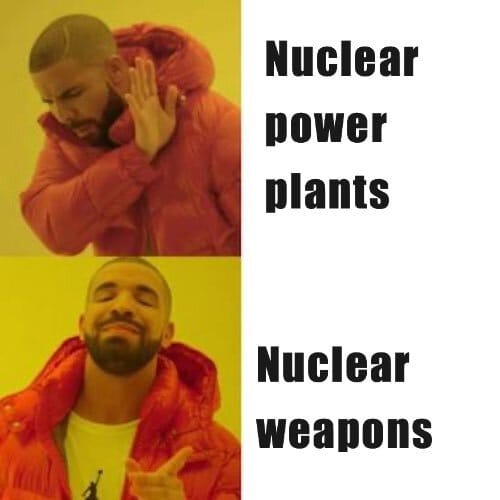
😂Meme of The Week

That’s it for this time.
Until next time, stay bright, stay critical (like a reactor), and keep glowing! 😎
-Fredrik
Like the newsletter and want to support it? Join Premium.
💪Review of the Week

What did you think of this week's email? |
DISCLAIMER: None of this is financial advice. This newsletter is strictly educational and is not investment advice or a solicitation to buy or sell any assets or to make any financial decisions. Please be careful and do your own research
Reply