- Nuclear Update
- Posts
- ⚛️Japan–U.S. $40B SMR buildout
⚛️Japan–U.S. $40B SMR buildout
PLUS: First Reactor at INL in 50 Years
Welcome to Nuclear Update, the only newsletter that explains billion-dollar nuclear buildouts before your coffee gets cold.
This is what I’ve got for you this week:
⚛️ Japan–U.S. $40B SMR buildout
🏗️ First Reactor at INL in 50 Years
🟢 DOE Clears Oklo’s First Reactor Design
✍️ Guest Post: What 40 Years in Nuclear Taught Me About Batteries
But first: I’ve been getting more messages lately from readers asking how to land a job in the nuclear sector.
So quick check:
Are you currently looking for a job in nuclear? |
Last week, I asked:
The color part of the eye is the...
You said:
⬜️⬜️⬜️⬜️⬜️⬜️ Cornea (9%)
🟩🟩🟩🟩🟩🟩 Iris (82%)
⬜️⬜️⬜️⬜️⬜️⬜️ Pupil (9%)
Now, let’s dive into the good stuff! 💥

⚛️ Japan–U.S. $40B SMR buildout
The U.S. and Japan just announced an agreement to boil water together…
On March 19 President Trump and Prime Minister Sanae Takaichi announced plans for a $40 billion nuclear buildout, centered around deployment of BWRX-300 small modular reactors across Tennessee and Alabama.
The BWRX-300 is, as the name politely suggests, a 300 MWe Boiling Water Reactor, a smaller version of the same basic reactor family that has been running commercially for decades.
It’s sales pitch is not to reinvent nuclear with advanced thorium breeding technology and molten salt storage, but simply to shrink a basic reactor, standardize it, and make it easier to build in repeatable batches.
While specific timelines and final reactor counts have not yet been disclosed, the most comparable project is Ontario’s Darlington project: 4 BWRX-300 with a total estimated cost of CAD 20.9 billion (roughly USD 15 billion).
On that basis, US$40 billion would imply something like 11 BWRX-300s if the scope is broadly comparable.
GE Hitachi has previously talked about the BWRX-300 targeting less than $3,000 per kW and roughly $1 billion per unit. Then $40 billion could theoretically stretch to 40 units.
That is the blue-sky case, and probably the one best left in the vendor slide deck for now. Still, even if we stay conservative and use the Darlington-style benchmark instead of the glossy brochure math, this is not a small project.
If you want the uranium demand math behind this, I broke it down in last week’s Nuclear Update Premium, along with my full portfolio and how I’m positioned 👉 https://nuclearupdate.com/p/nuclear-update-premium-march-21-2026
🏗️ First Reactor at INL in 50 Years
Aalo announced that it has completed assembly of its Critical Test Reactor at Idaho National Laboratory (INL), marking the first new reactor at INL in 50 years.
The reactor is part of Aalo-X, the company’s experimental power plant built to prove its 10 MWe Aalo-1 design, a sodium-cooled microreactor that Aalo ultimately wants to scale into 50 MWe Aalo Pod power plants for data centers and other power-hungry customers.
The timing is part of a much bigger push. DOE’s Reactor Pilot Program is aiming to get at least 3 advanced reactors to criticality by July 4, 2026, and officials have recently suggested that as many as 4 could make it by then.
DOE has not published a definitive list, but Aalo, Oklo, Antares, and Last Energy have all signaled they are aiming for the July 4 timeline.
It is still early, and a test reactor is not the same thing as a commercial fleet. But after years of hearing that advanced reactors were always just around the corner, it is nice to see actual hardware.
🎥 Want to see what first reactor at INL in 50 years actually looks like? Check this out:
🟢 DOE Clears Oklo’s First Reactor Design
Oklo just got a green light, and no, not the glowing kind.
The company announced that the U.S. Department of Energy has approved the Nuclear Safety Design Agreement (NSDA) for its first reactor, the 75 MWe Aurora powerhouse at Idaho National Laboratory, alongside a signed agreement under the DOE’s Reactor Pilot Program.
It is not full approval yet, but it does give Oklo a pathway to move forward with the design, construction, and operation of its first reactor under DOE oversight.
Aurora is a fast reactor, meaning it runs on fast neutrons instead of the moderated neutrons used in traditional light water reactors. That allows it to extract more energy from the same uranium and opens the door to using recycled fuel.
Oklo also has something most advanced reactor companies do not. Fuel.
The company secured access to recovered material from the Experimental Breeder Reactor-II program (EBR-II), one of the most successful fast reactor demonstrations in U.S. history.
Instead of waiting on new enrichment or entirely new fuel supply chains to be built out, it can move forward using material that already exists.
This means Oklo is moving beyond slides and into the part that matters: actually trying to build the thing.
✍️ Guest Post: What 40 Years in Nuclear Taught Me About Batteries
Bob Ciminel is back. For those who missed his earlier piece, Bob spent more than 40 years in nuclear power, including seven years running naval nuclear propulsion plants.
This time, he’s breaking down something every energy system eventually runs into: batteries, and why in nuclear, they’re only ever a temporary solution.
By Bob Ciminel
Apologies to those of you who have electric vehicles, but I have an ingrained aversion to all things powered by batteries, apart from my Toyota hybrid. I attribute it to my 40-plus years in nuclear power and the seven years I spent running naval nuclear propulsion plants.
Even nuclear submarines rely on a battery when things become pear-shaped. A reactor trip (or scram for us old folks) will compromise the steam going to the ship’s service turbogenerators, affecting the AC power system.
My submarine had a 2,600-ampere-hour battery and 125-volt DC/480-volt AC motor generators that would provide power to essential equipment until we restored reactor power or started the emergency diesel generator. The battery would last for 24 to 50 hours with our electrical loads reduced to the absolute minimum.
Commercial nuclear power plants built in the 1960s and 1970s have large emergency diesel generators that automatically start and supply power if the reactor trips and offsite power is not available.
During the brief time it takes for the diesels to start and load multiple 125-volt DC batteries provide power through 120-volt AC inverters to critical components.
The bulk of today’s nuclear plants can only last between four and eight hours before they can no longer remove decay heat.
The Westinghouse AP-1000 advanced reactor uses 250-volt DC batteries and uninterruptible power supplies that can provide emergency power up to 72-hours before needing diesel generators, and passive emergency cooling systems can run for weeks.
What all the above have in common is that batteries can only last for a finite amount of time. All batteries are subject to the Peukert Law, which states that the faster you discharge a battery the sooner it will die.
This is particularly true for the lead-acid batteries currently used in most nuclear plants. (The thermal runaway issue affecting lithium-ion batteries makes them unsuitable.)
Whether it is a submarine, nuclear power plant, or an EV, the one thing affecting them all is, if you are running on batteries conditions never improve.
Big thanks to Bob Ciminel for this one, 40+ years in nuclear tends to give you a perspective worth listening to.
That’s a wrap for this week’s edition.
Until next time: stay charged, stay critical (like a reactor), and keep glowing 😎
-Fredrik
Like the newsletter and want to support it? Join Premium.
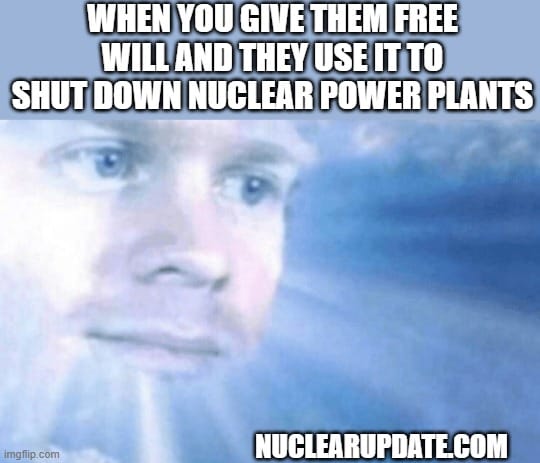
😂Meme of The Week
💪Review of the Week

What did you think of this week's email? |
DISCLAIMER: The content in this article is for informational and educational purposes only and is not financial advice. It should not be interpreted as a recommendation or solicitation to buy or sell any securities. Markets move quickly, opinions can change, and outcomes are uncertain. Always consult a licensed professional before making any investment decisions. Nuclear Update and its authors are not responsible for any gains or losses arising from the use of this information.
Reply