- Nuclear Update
- Posts
- ⚛️New York Plans 5 GW of New Nuclear
⚛️New York Plans 5 GW of New Nuclear
PLUS: NASA and DOE want a Moon reactor by 2030
Welcome to Nuclear Update, the newsletter that goes fishing for fission facts.
This is what I’ve got for you this week:
⚛️New York Plans 5 GW of New Nuclear
🌙NASA and DOE want a Moon Reactor By 2030
🇩🇪 Germany's Chancellor Calls Nuclear Exit a Mistake
☢️ Atoms as Antennas
But first: this week’s trivia question:
What process lets plants convert sunlight into energy? |
Last week, I asked: Changing the number of neutrons in an atom changes its:
You said:
🟩🟩🟩🟩🟩🟩 Isotope (57%)
🟨🟨⬜️⬜️⬜️⬜️ Element (21%)
⬜️⬜️⬜️⬜️⬜️⬜️ Ion (4%)
🟨⬜️⬜️⬜️⬜️⬜️ Charge (18%)
Now, let’s dive into the good stuff!💥

⚛️New York Plans 5 GW of New Nuclear
New York Governor Kathy Hochul decided to go big instead of going home, and is scaling up her nuclear ambitions to 5 GW of new nuclear capacity (up from 1 GW).
“Our initiative to create a nuclear reliability backbone for New York will ensure safe, around-the-clock, emission-free power to help keep the lights on and rates down”, Hochul said.
To put that number in perspective: 5 GW is about 5 conventional reactors, or a whole fleet of SMRs if the state goes the advanced reactor route. Either way, this would be more new nuclear capacity than the US has added in a long time.
The plan is two steps: New York’s Power Authority keeps pushing the first 1 GW project, and now the Public Service Commission is mapping out a cost-effective pathway for another 4 GW on top.
New York’s 4 existing reactors (3 BWRs and 1 PWR, about 3.4 GW total) run like metronomes, and if you want a clean grid that still works on windless nights and cloudy weeks, you need something that does not clock out. That’s the pitch.
There’s also a workforce angle baked in: NextGen Nuclear New York, a training push to build a skilled in-state nuclear workforce, aligning education and credentials with industry needs, and helping existing energy workers transition into nuclear roles.
🌙NASA and DOE want a Moon reactor by 2030
The Moon is about to get the most Extreme Makeover: Home Edition upgrade in human history.
NASA and the US Department of Energy just signed an MOU to renew their commitment to develop a fission surface reactor for use on the Moon and future NASA missions to Mars.
This follows Trump’s December 18, 2025 executive order, “Ensuring American Space Superiority,” which puts nuclear on the Moon on the official to do list: Americans back by 2028, early outpost infrastructure, and a lunar surface reactor ready by 2030.
This isn’t a brand new idea. Back in 2022 (that’s even before this newsletter!), NASA and DOE picked 3 teams to develop early design concepts for a 40 kW lunar reactor system designed to operate for at least 10 years. The winners were Westinghouse, Lockheed Martin, and IX, a joint venture between Intuitive Machines and X-Energy.
This is all part of Artemis, NASA’s plan to establish a long-term human presence on the Moon, and then eventually on Mars.
And yes, there’s a geopolitical timer running too. China and Russia have talked about nuclear power for their International Lunar Research Station plans, with a lunar reactor target around 2035.
Space race 2.0, but with nuclear reactors.
🇩🇪 Germany's Chancellor Calls Nuclear Exit a Mistake
Germany’s chancellor just said the obvious part out loud.
Friedrich Merz admitted Germany’s nuclear phaseout was a “serious strategic mistake”, and blamed past governments for turning the “Energiewende” into the world’s most expensive energy transition.
Even if Germany wanted to exit nuclear, they should have kept the last reactors on the grid until replacement capacity was actually in place, especially when Europe was staring straight at an energy crisis.
Instead, Germany shut its final 3 reactors in April 2023 and gave itself less firm power to work with right when the system needed it most.
Merz tied it directly to today’s reality: not enough generation capacity, higher costs, and continuous government intervention just to keep energy prices from blowing out.
When your plan needs permanent subsidies to keep the lights on, the spreadsheet is trying to tell you something.
Here’s the moment he says it out loud:
📈Price Floors and Diplomacy
Last week in Premium, we covered uranium spot hitting an 18 month high, Trump’s executive order opening the door to a uranium price floor, and Canada and China signing an agreement to “strengthen cooperation in natural uranium trade.”
Uranium is back in energy diplomacy.
If you’re still watching this sector from the sidelines, this is where it gets expensive.
Join Nuclear Update Premium to see how we’re positioning for the nuclear renaissance.
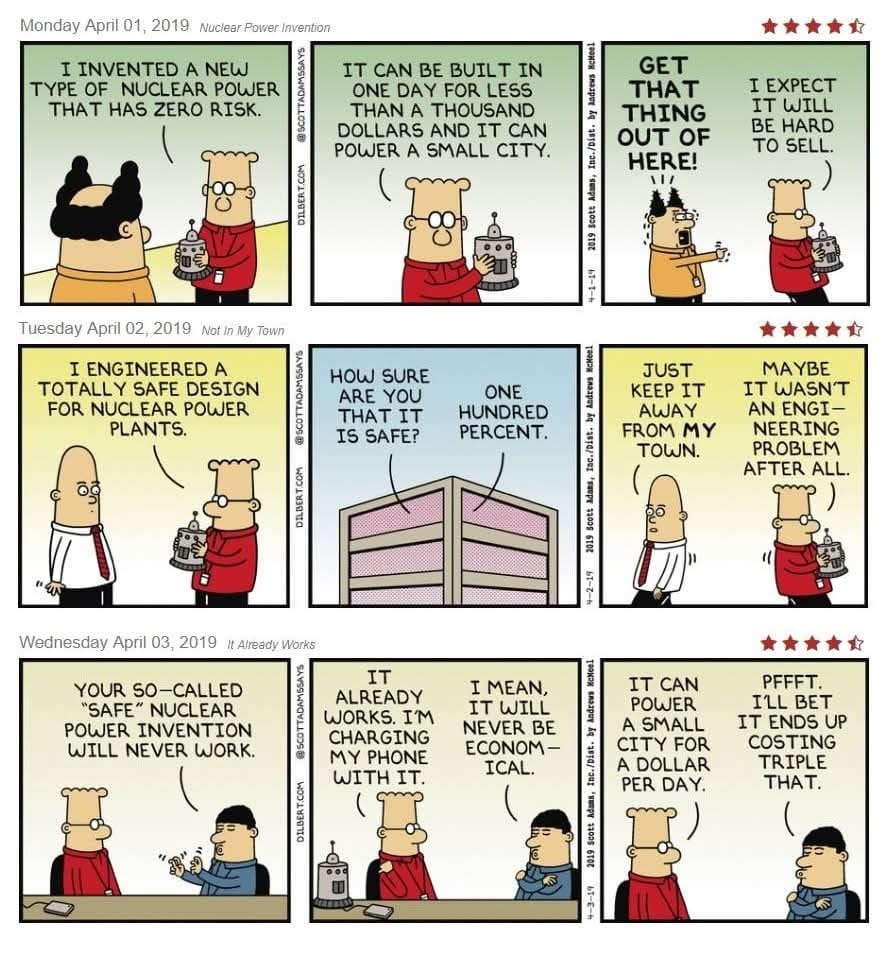
🕯️ RIP Scott Adams
Scott Adams, the creator of Dilbert, has passed away at 68 after battling prostate cancer.
However you feel about him, Dilbert nailed one thing better than almost anything else on the internet: the daily absurdity of modern work, the meetings and the buzzwords.
Here are a few Dilbert nuclear strips, sharp and painfully familiar.
☢️ Atoms as Antennas
Welcome back to Atomic Alternatives, where we explore how atoms can do a lot more than generate electricity.
This week’s contender: atoms that act like antennas.
The trick is something called a Rydberg atom. Think of it as a normal atom, but with its outer electron kicked way out into a huge orbit.
When that happens, the atom becomes ridiculously sensitive to tiny electric fields. And radio frequency signals are basically just oscillating electric fields.
So instead of using a metal antenna to pick up a signal, you can use a little cloud of atoms and read out how the atoms react to it.
Why is that cool?
Because you can detect very weak radio signals, sometimes across a wide range of frequencies, and you can do it with something that’s tiny and lightweight.
It can fingerprint a signal (where it is in frequency, how strong it is, what its pulse pattern looks like), but reading the actual payload is a separate problem.
That opens the door to new kinds of communications sensing. Around airports, dense cities, and critical sites, being able to detect interference, spoofing, or unexpected transmissions is getting more important.
It’s also one of those ideas that feels like cheating. We spent a century building better antennas, then physics shows up and says: you could just use an atom, it’s already built for this.

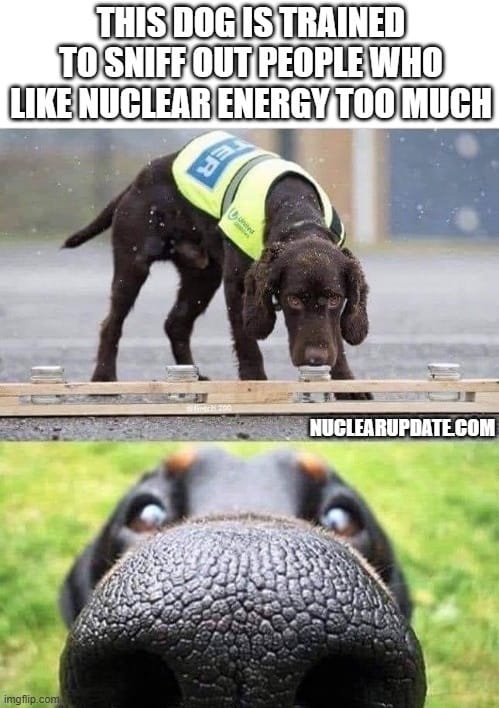
😂Meme of The Week
Thanks for reading, see you next week!
-Fredrik
Like the newsletter and want to support it? Join Nuclear Update Premium.
💪Review of the Week

What did you think of this week's email? |
DISCLAIMER: None of this is financial advice. This newsletter is strictly educational and is not investment advice or a solicitation to buy or sell any assets or to make any financial decisions. Please be careful and do your own research
Reply