- Nuclear Update
- Posts
- ⚛️NRC Unveils New Reactor Licensing Process to Speed Deployment
⚛️NRC Unveils New Reactor Licensing Process to Speed Deployment
PLUS: Vietnam to Build 2 VVER-1200 Reactors
Welcome to Nuclear Update!
I wanted to start this newsletter with a chemistry joke. But all the good ones argon.
This is what I’ve got for you this week:
⚛️ NRC Unveils New Reactor Licensing Process to Speed Deployment
🏗️ Vietnam to Build 2 VVER-1200 Reactors
🇪🇺 Europe’s Nuclear Sector Launches Action Plan for Nuclear
🔋 Atomic Alternatives: Uranium Batteries
But first, this week’s trivia question:
Which principle states that you cannot know both the exact position and momentum of a particle at the same time? |
Last week, I asked:
Are you currently looking for a job in nuclear?
You said:
🟨🟨⬜️⬜️⬜️⬜️ Yes (19%)
🟩🟩🟩🟩🟩🟩 No (81%)
Now, let’s dive into the good stuff! 💥

⚛️NRC Unveils New Reactor Licensing Process to Speed Deployment
For decades, getting a new reactor licensed in America has moved at roughly the speed of Tenet’s plot: long, complicated, and requiring several re-reads.
Now it is changing.
The U.S. Nuclear Regulatory Commission just unveiled Part 53, a new reactor licensing pathway designed to speed up deployment of advanced reactors while still keeping the safety bar intact.
It is the first new reactor licensing framework since Part 52 in 1989.
Up until now, advanced reactor companies have been trying to squeeze very different technologies into licensing processes originally built around large light-water reactors.
That is like trying to review an iPhone using the rulebook for a fax machine. Technically possible, probably, but not exactly efficient.
Existing regulations under Part 50 were built around light-water reactor technology, while many advanced designs use very different approaches.
Under Part 53, applicants will no longer need to ask for exemptions from rules written for reactors they are not even building.
It means the NRC has finally stopped pretending every future reactor looks like the old ones.
And the timing is not random. The move comes just as the DOE also announced more than $320 million in new scientific research funding across materials science, fusion, nuclear physics, quantum computing, advanced reactor sensors, fuel cladding, and nonproliferation tools.
If you want the investor angle on how regulatory changes like this translate into uranium demand and portfolio positioning, I break that down every week in Nuclear Update Premium 👉https://nuclearupdate.com/p/nuclear-update-premium-march-28-2026
🏗️ Vietnam to Build 2 VVER-1200 Reactors
Vietnam’s nuclear comeback just got a lot more concrete, pun intended.
The country has now signed an agreement with Russia to build its first nuclear power plant, Ninh Thuan 1, with 2 VVER-1200 reactors.
The VVER-1200s are large-scale Russian pressurized water reactors with 1,200 MWe each. They are part of Russia’s established export model, which is exactly why they keep showing up in emerging nuclear markets.
Vietnam is also planning to build a second nuclear plant, again with 2 reactors.
Nothing has been formally confirmed yet for that second site, but it would not be surprising if it also ends up going to the Russians with another pair of VVER-1200s.
If you are building your first fleet from scratch, standardizing around one proven design is the obvious move.
Vietnam says it wants to complete both plants by the end of 2030.
Oh, and each VVER-1200 consumes roughly 450,000 pounds of uranium per year, which means all 4 reactors would consume about 1.8 million pounds annually once fully online, for the next 60 to 80 years.
🇪🇺 Europe’s Nuclear Sector Launches Action Plan for Nuclear
Brussels-based nucleareurope just published a full action plan for nuclear, laying out how EU policy needs to change if Europe actually wants more reactors on the grid.
Europe is trying to do the Fantastic 4 at the same time: decarbonize, secure energy supply, keep power affordable, and stay industrially competitive.
The problem is that doing all 4 without nuclear has been… complicated.
The new action plan consists of 5 things:
A long-term policy framework that gives investors confidence.
A financial system that actually supports nuclear projects.
Faster regulation to speed up deployment.
Investment across the full fuel cycle.
And a supply chain that stays inside Europe.
None of that is particularly controversial. What is new is the level of urgency.
Europe’s energy system is under pressure from every angle. Electricity demand is rising, driven by electrification, data centres, and industry trying to decarbonize.
At the same time, energy security has become a geopolitical issue, with more than 58% of EU energy still coming from imports .
The industry is pointing toward around 150 GW of nuclear capacity in Europe by 2050, enough to power more than 250 million homes if the right policies are put in place.
And that is really what this plan is about. Not whether Europe should build nuclear. But how Europe is finally supposed to make it happen.
Nuclear Artifact of The Week
Before kids were glued to iPads, some were apparently firing up toy nuclear reactors.
In the 1950s, Louis Marx and Company sold the Linemar Atomic Reactor, a tin toy steam engine.
It came with a water tank and boiler disguised as a reactor dome, Esbit tablets to heat the water, a battery-powered cooling tower light, and even a little guard rail to keep things “safe”.
Basically, it was the atomic age turned into a toy box.
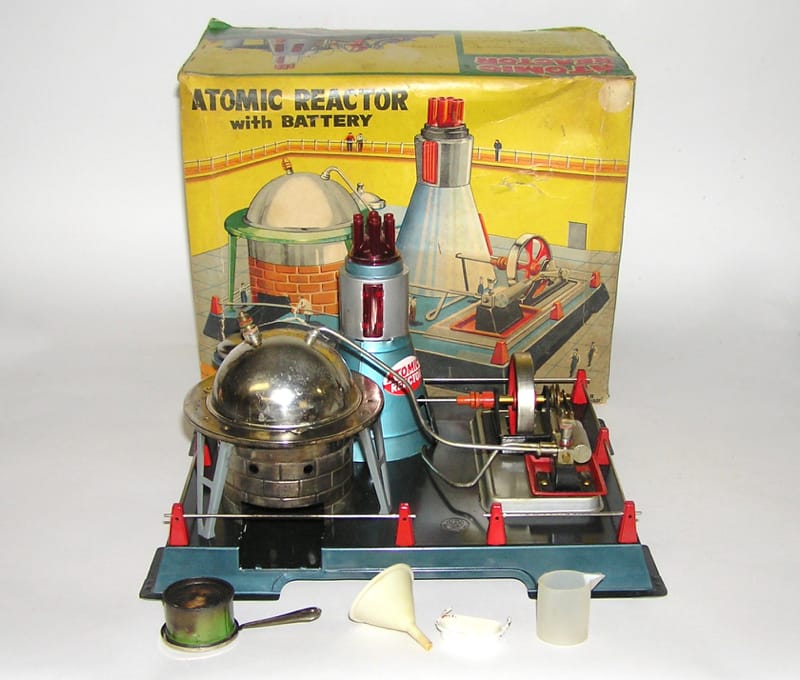
It sold for about $19.95 in the mid-1950s, which was not exactly pocket change back then, roughly $190+ in today’s money. These days, collectors will pay anywhere from $300 to $700 for one.
So yes, there was a time when “family fun” included giving your child a miniature steam-powered atomic reactor.
Different era.
🔋Uranium Batteries
Welcome back to Atomic Alternatives, where we explore the weird, unexpected, and occasionally “wait, that’s actually clever” ways nuclear shows up outside of reactors.
This week: uranium in rechargeable batteries.
Yes, uranium is not just for powering reactors, it’s also for storing electricity.
The idea comes down to chemistry. Uranium can exist in multiple oxidation states, meaning it can gain and lose electrons in different ways.
That makes it interesting for electrochemical storage, the same basic principle behind lithium-ion batteries.
What makes this more than just a nerdy lab curiosity is that researchers in Japan published a 2025 proof-of-concept study showing a rechargeable battery that used uranium as the active material and demonstrated repeated charge and discharge behavior.
Earlier uranium-battery work was mostly theoretical, while this one actually showed the concept could function in a real battery system.
Uranium can transfer more electrons per reaction than many conventional battery materials. More electrons means more energy stored per unit, which is the holy grail in battery development.
Uranium has always been about producing energy. The idea that it could also help store it opens up a completely different angle on the element.
From fuel rods to batteries, not bad for one metal.
That’s a wrap for this week.
Until next time: stay charged, stay critical (like a reactor), and keep glowing 😎
-Fredrik
Like the newsletter and want to support it? Join Premium.
😂Meme of The Week

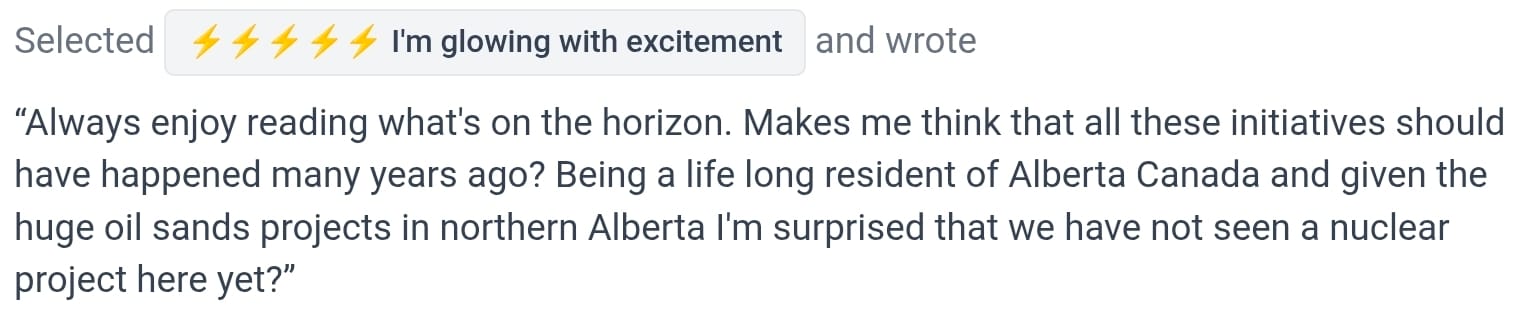
💪Review of the Week
DISCLAIMER: The content in this article is for informational and educational purposes only and is not financial advice. It should not be interpreted as a recommendation or solicitation to buy or sell any securities. Markets move quickly, opinions can change, and outcomes are uncertain. Always consult a licensed professional before making any investment decisions. Nuclear Update and its authors are not responsible for any gains or losses arising from the use of this information.
Reply