- Nuclear Update
- Posts
- ⚛️Pentagon Pays $169M for Nuclear Supply Chain
⚛️Pentagon Pays $169M for Nuclear Supply Chain
If there’s any doubt that the U.S. is driving the nuclear renaissance, well, let’s just say you probably haven’t been doing your homework. Washington isn't just idly standing by, it is actively driving this trend by approving restarts for existing nuclear power plants, extending their operating licenses, and actively approving and supporting the construction of new reactors.
Welcome to Nuclear Update.
If there’s any doubt that the U.S. is driving the nuclear renaissance, well, let’s just say you probably haven’t been doing your homework.
Washington isn't just idly standing by, it is actively driving this trend by approving restarts for existing nuclear power plants, extending their operating licenses, and actively approving and supporting the construction of new reactors.
It’s also rebuilding the entire nuclear ecosystem around those reactors, from mining and enrichment to conversion, fuel fabrication, and now the upstream chemicals that make the whole system possible in the first place.
Near the top of that system sits a mineral most people have never heard of: fluorspar.
And now the U.S. Department of Defense is paying $169 million to secure acid-grade fluorspar for the National Defense Stockpile.
Uncle Sam is actively buying one of the key inputs required to produce nuclear fuel at industrial scale.
Before this contract makes sense, you need to understand why a pretty purple rock suddenly became a national security priority.
Today’s edition is sponsored by CleanTech CTV, and the timing couldn’t be more relevant.
If you missed the earlier Fluorspar Series, you can catch up here: Fluorspar: The Key Mineral for Enrichment

⚛️ The Chemistry Behind Enrichment
Fluorspar, or fluorite, is calcium fluoride (CaF₂) and it doesn’t get much media love, but it’s the backbone of modern technology.
You can’t make hydrofluoric acid (HF) without fluorspar.
You can’t make UF₆ (the gas used for uranium enrichment) without HF.
And you definitely can’t fuel reactors without UF₆.
HF isn’t easily replaceable. It’s one of the few chemicals capable of binding with uranium to form UF₆. Without it, uranium simply can’t enter the enrichment process.
That means enrichment capacity isn’t just a question of uranium supply or centrifuge technology, it’s also a chemistry problem.
Even if a country mines uranium domestically, it still depends on reliable fluorine chemistry to turn that material into usable nuclear fuel.
In practice, the nuclear fuel cycle runs as much on chemical processing as it does on reactors and mining.
Fluorspar is also the mineral that makes everything from batteries, refrigerants, and advanced manufacturing possible, but this is a nuclear newsletter, so we’ll stick to the fuel chain.
Acid grade fluorspar (acidspar) is the high-purity version (97%+) used to produce hydrofluoric acid (HF). Lower grades can go into steel and ceramics. Acidspar is the good stuff you save for the technically complex stuff (like the nuclear fuel chain).
China dominates global supply, producing about 5.9 million tons out of roughly 9.5 million tons worldwide in 2024, around 62% of world mine output.
China also controls much of the downstream processing capacity that turns fluorspar into HF. Over decades, Western production declined as cheaper Chinese supply filled the market, leaving the U.S. almost entirely dependent on imports for a material that sits inside critical technologies.
But now Uncle Sam is paying to change that.
🇺🇸 Washington Buys Fluorspar for $169 Million Contract
Over the past year, Washington has started rebuilding the National Defense Stockpile.
Public filings and reporting throughout 2025 showed a roughly $1 billion critical minerals buying program, targeting materials where supply chains are heavily concentrated overseas (read China).
Just this past week the U.S is pitching a critical minerals price floor system to allied countries.
Stockpile contracts create demand certainty, and price floors are designed to make project economics financeable even if China leans on the market and squeezes margins right as Western supply tries to scale.
The goal is to rebuild strategic buffers for materials that underpin weapons systems, electronics, energy infrastructure, and advanced manufacturing.
And fluorspar just made the Pentagon’s shopping list.
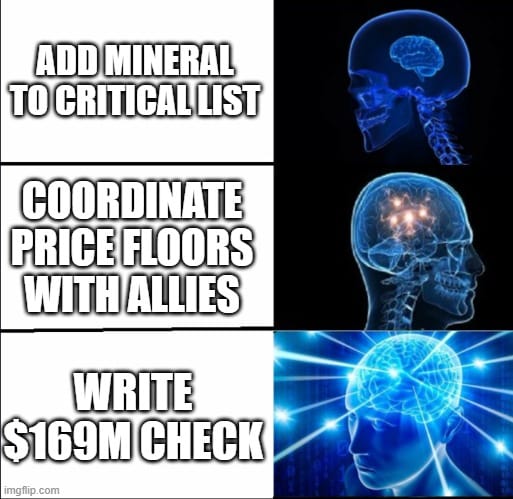
On December 29th, 2025, The Department of Defense started purchasing acidspar, securing $169 million of acidspar supply for the National Defense Stockpile.
That’s enough money to buy roughly 560 million pounds of acidspar.
The deal is structured as a 5-year IDIQ contract: Indefinite Delivery, Indefinite Quantity. Rather than one giant purchase order, the government issues delivery orders over time under a single umbrella agreement.
Each delivery order has quantities, pricing tiers, acceptance specs, and delivery deadlines defined upfront. It gives the Pentagon predictable terms, and it gives the supplier a clear target to build capacity against.
That is important because the domestic supplier base for acidspar is extremely thin.
When the government starts buying supply through multi-year frameworks, U.S. companies with scale and a clear route to production get the spotlight.
This is where CleanTech CTV becomes relevant.
CleanTech CTV: America’s Fluorspar Comeback
As rivals tighten their grip on critical minerals, America’s answer is emerging from the heartland.
In 2024, CleanTech CTV (TSXV: CTV.v; OTCQB: CTVFF) began consolidating claims across the Illinois–Kentucky Fluorspar District, positioning itself as the largest active developer in the region.
The company is built around a simple thesis: if the United States wants domestic fluorspar supply again, it will likely come from districts that have already produced it before.
CleanTech controls a large land position in a district that once supplied the majority of U.S. fluorspar and is still considered one of North America’s most prospective fluorine systems.
Rather than chasing isolated targets, the company’s strategy has been to consolidate mineral rights across the broader district, building a scalable platform rather than a single-asset story.

CleanTech’s approach combines exploration upside, royalty exposure, and targeted land acquisitions tied to historical production zones, all aimed at rebuilding fluorspar supply inside U.S. borders.
And with the policy backdrop, fluorspar is now being treated like a strategic input, and that puts proven U.S. districts directly on Washington’s radar.
Since the last deep dive, CleanTech has expanded its footprint in two concrete ways.
First, the company expanded its royalty agreement with Oracle Commodity Holding Corp. to include 37 additional Illinois parcels totaling 1,605 acres, increasing district-level exposure to potential future production without needing to finance every stage of development directly.
Second, CleanTech consolidated additional mineral rights around Hicks Dome with another 1,605-acre acquisition, which nearly doubled its fluorspar holdings in Illinois to 2,846 acres, and lifted total district holdings to over 17,750 acres across Kentucky and Illinois.
Together, CleanTech is stacking the two ingredients Washington keeps paying for: U.S. jurisdiction and scale. The purple rock is now strategic, and CleanTech is trying to own as much of the right district as possible.
⚛️ Wrapping Up
For decades, fluorspar sat quietly in the background of the nuclear fuel cycle, essential but largely ignored.
That changed the moment the Pentagon started writing checks for domestic supply.
Stockpiles, multi-year procurement contracts, and potential price floors all point in the same direction: Washington wants domestic capacity, and it is increasingly willing to pay to make it happen.
That’s the environment CleanTech CTV is positioning itself for. As Washington starts backing domestic supply, the company has been steadily expanding its footprint in the Illinois–Kentucky Fluorspar District as it builds toward potential future U.S. production.
– Fredrik
For more information on CleanTech’s work to close the HF gap, visit their website www.cleantechctv.com or contact John Lee at [email protected], for more information on fluorspar, visit fluorspar.com
What did you think of this week's email? |
Disclosure: Nuclear Update (“NU”) is an independent publication focused on uranium, energy, and related markets. Data and information in this article are provided from third-party sources, and NU is not responsible for their accuracy or completeness. Readers should always perform their own research and due diligence on any company or investment discussed. NU does not provide personalized investment advice and is not an investment advisor; any companies or profiles mentioned may not be suitable for all investors. NU received compensation from CleanTech CTV for the preparation and dissemination of this sponsored edition.
DISCLAIMER: The content in this article is for informational and educational purposes only and is not financial advice. It should not be interpreted as a recommendation or solicitation to buy or sell any securities. Markets move quickly, opinions can change, and outcomes are uncertain. Always consult a licensed professional before making any investment decisions. NU and its authors are not responsible for any gains or losses arising from the use of this information.
Reply