- Nuclear Update
- Posts
- ⚛️U.S. Launches the Genesis Mission
⚛️U.S. Launches the Genesis Mission
PLUS: China Just Made a Supercritical Advancement
Welcome to Nuclear Update!
We’re running on pure supercritical energy this week, fully Brayton-cycle optimized (you’ll get the joke later).
This is what I’ve got for you this week:
⚛️U.S. Launches the Genesis Mission
😧China Just Made a Supercritical Advancement
🌍 A Global Wave of Nuclear Money Is Starting to Hit
⚡The Radiation Keeping Your Food Fresh
But first: this week’s trivia question:
In the periodic table, what does an element’s atomic number represent? |
Last week, I asked: In the nuclear world, what does the acronym NORM stand for?
You said:
⬜️⬜️⬜️⬜️⬜️⬜️ Nuclear Output Regulation Machine (2%)
🟨⬜️⬜️⬜️⬜️⬜️ National Organization of Reactor Managers (11%)
⬜️⬜️⬜️⬜️⬜️⬜️ Neutrons Occasionally Rearranging Molecules (1%)
🟩🟩🟩🟩🟩🟩 Naturally Occurring Radioactive Material (86%)
Now, let’s dive into the good stuff!💥

⚛️U.S. Launches the Genesis Mission
President Trump has launched the Genesis Mission, a national AI acceleration program, compared to the Manhattan Project and Apollo.
The goal is simple in writing, a small step on paper… but a giant leap in practice. Use artificial intelligence across the Department of Energy’s national labs to double America’s scientific output and cement U.S. dominance in energy, technology, and national security within 10 years.
The Genesis Mission essentially fuses the entire DOE ecosystem into one accelerated R&D engine. It links national lab supercomputers, AI training environments, experimental testbeds, and manufacturing facilities into a unified system designed to iterate breakthroughs at high speed.
That system will train models on the world’s largest scientific dataset collection and deploy AI agents capable of designing new materials, optimizing reactor components, predicting system behavior, and automating entire research workflows.
Nuclear fission and fusion are listed as top priority domains. Trump’s executive order frames energy security as central to AI leadership, and Energy Secretary Chris Wright say that the Mission will directly tackle the grid problem.
The U.S. needs a lot more energy, a lot cheaper, and a lot faster.
The scale becomes almost impossible to overstate. This mission will deploy 40,000 scientists to merge fission and fusion with AI.
Fusion research is about to accelerate dramatically. Advanced fission design cycles are about to get shorter. Materials testing for high-temperature reactors becomes faster. Fuel development and safety modeling become cheaper.
DOE’s capabilities are being turned into an AI-driven closed loop that can iterate, test, and refine at a pace the nuclear sector has never seen.
The Genesis Mission is the clearest signal yet that nuclear is moving from “clean energy option” to “strategic infrastructure,” and the cycle implications are enormous. In short, energy security is now AI security, and AI security runs on fuel.
More to come as this evolves, but the direction of travel is unmistakable. Nuclear just got pulled into the center of America’s AI race.
😧China Just Made a Supercritical Advancement
China has activated the world’s first commercial power unit using supercritical CO₂, a technology that energy nerds have been buzzing about for over a decade, but that very few people realized was this close to deployment.
The system, developed by the China National Nuclear Corporation (yes, CNNC), replaces steam with high-pressure, high-temperature CO₂ to convert waste heat from steelmaking into electricity.
Right now, it sits inside a steel complex in Guizhou, China, feeding two 15 MW units into the grid with a reported 50% higher efficiency than traditional waste-heat systems.
To understand why this matters, you have to appreciate the physics.
Steam turbines run on the Rankine cycle, the old-school “boil water, spin turbine, cool it down, repeat” loop that every coal, gas, and most nuclear plants have used for more than a century. It works, but it’s bulky, it’s complex, and it hits efficiency ceilings that physics simply does not let you escape.
Supercritical CO₂ uses the Brayton cycle instead, a far smaller hardware, far higher efficiency, and a much tighter, simpler loop.
It’s like swapping a steam engine for a jet engine. sCO₂ turbines can be one-tenth the size and weight of steam systems and eventually cut turbine costs by the same margin.
At high pressure and temperature, CO₂ becomes a weird “not-quite-gas, not-quite-liquid” fluid that behaves like a turbocharged energy sponge.
For nuclear, this is huge. High-temperature reactors, molten salt reactors, sodium fast reactors, even mobile microreactors all play perfectly with sCO₂ Brayton cycles. You get higher efficiency, smaller hardware, cheaper components, and a much simpler plant architecture.
It is one of the most important enabling technologies for advanced nuclear, full stop.
Meanwhile, the U.S. equivalent, the DOE-backed STEP Demo project in Texas, is still in early testing, producing a few megawatts of synchronized power at 500°C as it crawls toward its 10 MW target.
The race is on, and China currently has the lead.
🌍 A Global Wave of Nuclear Money Is Starting to Hit
Something big is happening in nuclear finance, and it is happening everywhere at once. After years of being boxed out of climate funding, green taxonomies, and multilateral lending, nuclear has suddenly become the sector where the money is actively trying to go.
Three moves this week made that crystal clear.
First, the Asian Development Bank, one of the most influential development banks in the world with 69 member countries, has officially opened its doors to nuclear investment for the first time in its history.
The ADB’s new policy explicitly recognizes nuclear as a baseload alternative to fossil fuels, and it has already signed an agreement with the IAEA to begin identifying nuclear projects across Asia. That includes SMRs, fuel-cycle support, waste management, and full life-cycle capacity building.
Second, Japan is rolling out government-backed loan programs to directly finance new nuclear plants and transmission expansions. Tokyo is openly acknowledging that private capital alone cannot shoulder the scale of investment needed to rebuild its nuclear fleet.
This is coming from a country that once shuttered its entire fleet. Now it is offering state credit to restart reactors, finish construction, and build new ones. That is a 180-degree shift, and a massive signal to global investors.
Third, the UK just made nuclear officially eligible for green financing. Green gilts, green savings bonds, ESG-aligned government instruments, all of them can now be used to fund nuclear projects (like Sizewell C or future SMRs).
The European Court just dismissed Austria’s challenge against nuclear in the EU taxonomy, and the UK has pulled nuclear squarely into its green finance framework. For institutional investors, this is a green light they have been waiting on for a decade.
Money is no longer trickling into nuclear. It’s starting to pour.
🧠 Patience, Timing, and the Uranium Payoff
This week’s Premium edition features a special guest article from John Leggett, a retired publishing executive and long-time market trader.
John has been following the uranium space for years, and he brings a perspective most investors desperately need right now… patience with a purpose.
His piece, “Never Mistake a Clear View for a Short Distance”, digs into why volatility is a feature, not a bug, of this sector, and how the biggest returns tend to go to those who can sit still when the market tries to shake them out.
It is one of the clearest, most grounded breakdowns of uranium investor psychology you’ll read this year.
If you want to read the full guest article and get the rest of this week’s Premium analysis, you can join Nuclear Update Premium here👇
🎞️ How Many Bananas Would Make You Radioactive
Bananas are radioactive. Not “call the NRC” radioactive, but radioactive enough to make this question hilarious: how many would you need to eat to turn yourself radioactive?
This video answers it perfectly:
⚡The Radiation Keeping Your Food Fresh
Welcome back to Atomic Alternatives, where we explore the strange, clever, and occasionally ridiculous ways nuclear science sneaks into everyday life.
This week we’re heading into the grocery store aisle.
You might not realize it, but radiation is quietly extending the shelf life of your food, keeping it safer, fresher, and a whole lot less… moldy.
Food irradiation sounds like something a comic-book villain would propose, but unlike the villain, it actually works.
You expose food to a controlled dose of gamma rays, X-rays, or electron beams. That burst of radiation wipes out bacteria, parasites, and fungi, and slows down ripening and sprouting.
And no, the food does not become radioactive (no matter what your cousin on Facebook insists).
It’s basically pasteurization, but for solid food.
The most common source used worldwide is cobalt-60, which emits gamma rays that can pass through packaging and treat bulk products quickly and uniformly. Electron-beam systems and X-ray machines do the same job for smaller or more sensitive items.
Spices are one of the biggest examples, since raw spices can carry shockingly high bacteria loads. Irradiation wipes that clean.
Fresh fruits, vegetables, poultry, pork, seafood, even pet food use the same process to extend shelf life and reduce the risk of foodborne illness.
If you’ve eaten strawberries in January, herbs that somehow survived until the weekend, or a giant bag of pre-washed lettuce that somehow survived a week in your fridge… you’ve benefited from nuclear tech.
The doses are tiny and tightly regulated. You get safer food without preservatives or chemicals that change texture and taste.
Just a quick nuclear “polish,” and it’s good to go.⚛️

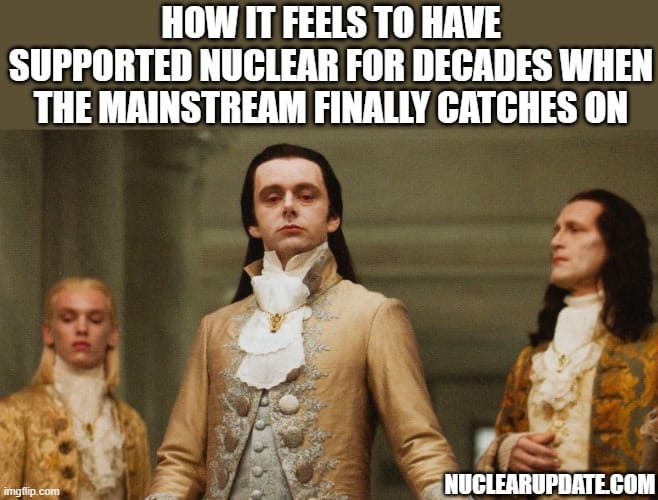
😂Meme of The Week
Until next time: stay charged, stay critical (like a reactor), and keep glowing 😎
— Fredrik
Want to support Nuclear Energy? Join Nuclear Update Premium.
💪Review of the Week

What did you think of this week's email? |
DISCLAIMER: None of this is financial advice. This newsletter is strictly educational and is not investment advice or a solicitation to buy or sell any assets or to make any financial decisions. Please be careful and do your own research
Reply