- Nuclear Update
- Posts
- ⚛️University Gets a Microreactor
⚛️University Gets a Microreactor
PLUS: NRC Reflects on 2025 Successes
Welcome to Nuclear Update, the newsletter where we watch the world slowly catch up to what we already know: carbon-free 24/7 nuclear power is the answer.
This is what I’ve got for you this week:
⚛️University of Illinois Gets a Microreactor
🤔NRC Reflects on 2025 Successes
📝Duke Energy Submits Site Application
☢️Nuclear Barcodes
But first: this week’s trivia question:
Which everyday activity gives you the highest radiation dose (on average)? |
Last week, I asked: Which group of elements in the periodic table is known as the "noble gases"?
You said:
🟨🟨🟨🟨🟨🟨 Group 1 (40%)
🟨🟨🟨⬜️⬜️⬜️ Group 2 (20%)
🟨⬜️⬜️⬜️⬜️⬜️ Group 17 (9%)
🟩🟩🟩🟩⬜️⬜️ Group 18 (31%)
Now, let’s dive into the good stuff!💥

⚛️University of Illinois Gets a Microreactor
NANO Nuclear Energy just signed a Memorandum of Understanding with the University of Illinois to collaborate on the development, construction, and operation of NANO’s KRONOS microreactor on university land.
This would be the first KRONOS MMR energy system, positioned as an advanced research reactor, meaning a real machine that students and researchers can learn from.
The near-term milestone is licensing. The University’s nuclear team says the plan is to submit a Construction Permit Application in Q1 2026. That is the real checkpoint (everything is just talk until the NRC paperwork hits the desk).
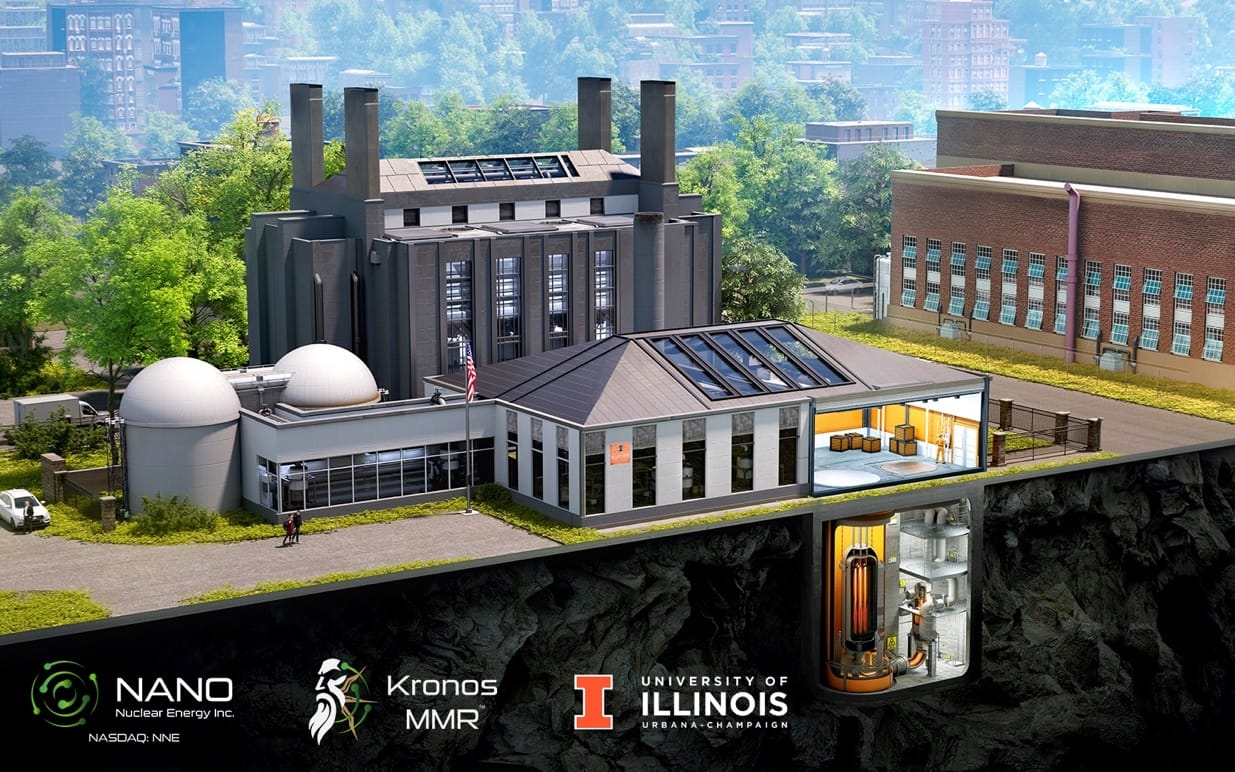
Rendering of KRONOS MMR on U. of I. Campus. (Image: NANO Nuclear)
The KRONOS MMR is a high temperature, helium cooled microreactor using TRISO fuel. The design output is up to about 15 MWe (roughly 45 MW thermal).
This is real progress for advanced nuclear. The MOU anchors KRONOS to a specific site and a credible partner, and it puts licensing front and center.
It is not commercial rollout yet. But it is a step closer to the only thing that counts in this industry: a reactor that actually runs.
Here’s NANO’s own quick walkthrough of KRONOS and why TRISO is the whole point:
🤔NRC Reflects on 2025 Successes
The NRC just dropped its 2025 highlight reel (sadly not named NRC wrapped): more approvals, faster timelines, same safety bar.
Operating Reactors
This is where the really powerful (but boring) stuff happened. The NRC approved 20-year license renewals for 13 reactors, each for 20 more years, keeping 12,000 MW on the grid. The cheapest clean electrons are the ones you already built.
They also authorized the Palisades restart, which is a U.S. first: a reactor getting regulatory approval to come back after entering decommissioning. And they are applying that playbook to two more restart projects, Crane Clean Energy Center and Duane Arnold.
New and Advanced Reactors
The NRC finished the technical review for TerraPower’s Kemmerer Unit 1 in 18 months, calling it their first approval of a non-light-water reactor in 50 years, and the first next-gen advanced reactor.
They also completed the NuScale US460 standard design approval review, and issued a construction permit for Kairos Hermes 2.
Fuel Facilities
Fuel cycle nerds, you get your own wins too.
The NRC approved 6 fuel facility requests in 2025, including continued HALEU related work at the American Centrifuge Plant in Ohio, and approval for Urenco USA to produce higher enriched U-235 for advanced reactor and accident tolerant fuel.
Going into 2026
The NRC says it’s actively working with Fermi America on a combined license application and an applicant led environmental impact statement pilot for a 4 unit AP1000 project in Texas.
They’re also preparing for the anticipated wave of 10 new applications from the U.S. Government.
Plus, they’re staying engaged with a long list of advanced players, including X-Energy, NuScale, University of Illinois, and TerraPower.
2026 is where we find out if this becomes a repeatable system, or just the best year-end slide deck in Washington.
📝Duke Energy Submits Site Application
Duke Energy, one of the largest U.S. utilities, just submitted an Early Site Permit application to the NRC for potential SMRs in North Carolina.
An Early Site Permit is the equivalent of reserving the table at the restaurant, before ordering your food.
What’s interesting is that Duke is keeping it technology neutral. Their application includes 6 possible reactor technologies, with 4 SMR designs and 2 non-light-water designs, and it specifically does not include big conventional light-water reactors.
While not official, prior planning docs have included familiar names like NuScale VOYGR, GE Hitachi BWRX-300, Holtec SMR-160, Westinghouse AP300 on the SMR side, and non-light-water options TerraPower Natrium and X-energy Xe-100.
Duke’s stated goal is to add about 600 MW of advanced nuclear by 2037.
That is not tomorrow morning, but it is an actual schedule, not a concept deck.
The location choice is very much on purpose. Belews Creek is an existing power station site. The plant has 2 units totaling about 2,200 MWe, coal and natural gas fueled, and it is currently scheduled to retire in the late 2030s.
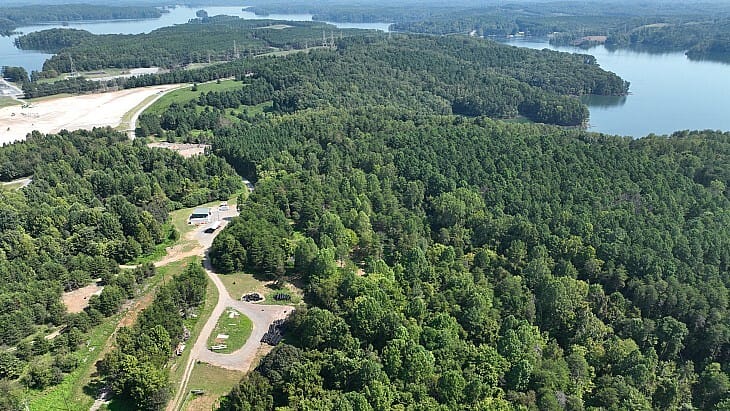
The proposed site at Belews Creek (Image: Duke Energy)
Repurposing an existing site is one of the few ways to make the economics less painful (the infrastructure and grid connections are already there!)
Also worth noting, this wasn’t a “riding the hype” moment. Duke says this application is the result of 2 years of work, and the NRC completed a pre-application readiness assessment before the submission.
📈 Premium Portfolio Updates
The Premium portfolio ended the year +89%.
If you want to see exactly how we’re positioned, Nuclear Update Premium includes a live portfolio with holdings, percentage allocations, and average entry prices, updated weekly.
Quick disclosure: this is not a day trading portfolio. It’s a “ride the nuclear renaissance” portfolio, don’t expect a lot of trades.
Premium also gets you the deeper stuff every Saturday: company and sector deep dives, uranium and macro commentary, insider transactions, plus timing tools like term vs spot, utility activity, and sentiment so you don’t have to stitch the puzzle together yourself.
If you like Nuclear Update but want the playbook, join me in Premium.
🎥True Scale of Atoms
Atoms are tiny. Everyone knows that.
But I don’t think most people feel how tiny they are. This video does the impossible, it makes atomic scale actually make sense, using the same kind of trick scientists use to “see” atoms in the first place.
Fair warning, you might never look at a penny the same way again.
☢️ Nuclear Barcodes
Welcome back to Atomic Alternatives, where we explore the strange, clever, and occasionally mind-bending ways nuclear science shows up in your life when you are not even looking for it.
This week’s cameo sounds like a German rock band, but it’s actually one of the coolest lab tools on Earth (and Mars).
Mössbauer spectroscopy.
Spectroscopy is how scientists ‘read’ a material. You shine a very specific kind of energy at it, then you look at what gets absorbed or what comes back. The pattern is a “barcode” that tells you what it’s made of and what state the atoms are in.
Mössbauer spectroscopy is the ultra precise version for certain nuclei, most famously iron. It works by firing gamma radiation at a sample and watching how iron atoms absorb it. Different iron minerals absorb it slightly differently, so you can tell if the iron is sitting in a rusty oxide, a sulfide, or something else entirely.
Once you can “read” iron that cleanly, a lot of doors open.
Materials science uses it to check what phases are in an alloy and whether heat treatment actually did what the engineer claims it did. Battery researchers use it to understand how iron based cathode materials change as they charge and discharge. Geologists use it to read the story of rocks, especially when the important clues are hiding in microscopic mineral grains.
And, it has literally been on Mars.
NASA’s Spirit and Opportunity rovers carried a mini-Mössbauer spectrometer on their robotic arms to identify iron bearing minerals in Martian rocks and soil.
There’s an entire corner of physics dedicated to listening to nuclei whisper, and it helps us build better materials, understand our planet, and decode rocks from other planets too.

😂Meme of The Week
Thanks for reading, see you next week, same time, same nuclear theme.
-Fredrik
Like the newsletter and want to support it? Join Nuclear Update Premium.
💪Review of the Week

What did you think of this week's email? |
DISCLAIMER: None of this is financial advice. This newsletter is strictly educational and is not investment advice or a solicitation to buy or sell any assets or to make any financial decisions. Please be careful and do your own research
Reply